HVAC & Furnace.
Heating and cooling is the system you notice only when it fails — usually at the worst time, and at altitude it works harder. Here’s what we check, what tends to go wrong, and the upkeep that keeps it running.
What we check during an inspection
We operate the system using normal controls and evaluate accessible, visible components.
✓ Heating equipment
We note the furnace or heat source’s type, approximate age, and operation, and visually check what’s accessible.
✓ Cooling equipment
We run the AC or heat pump (in suitable weather), noting age and condenser condition.
✓ Ductwork & airflow
We check visible ducts and registers and note rooms with weak airflow.
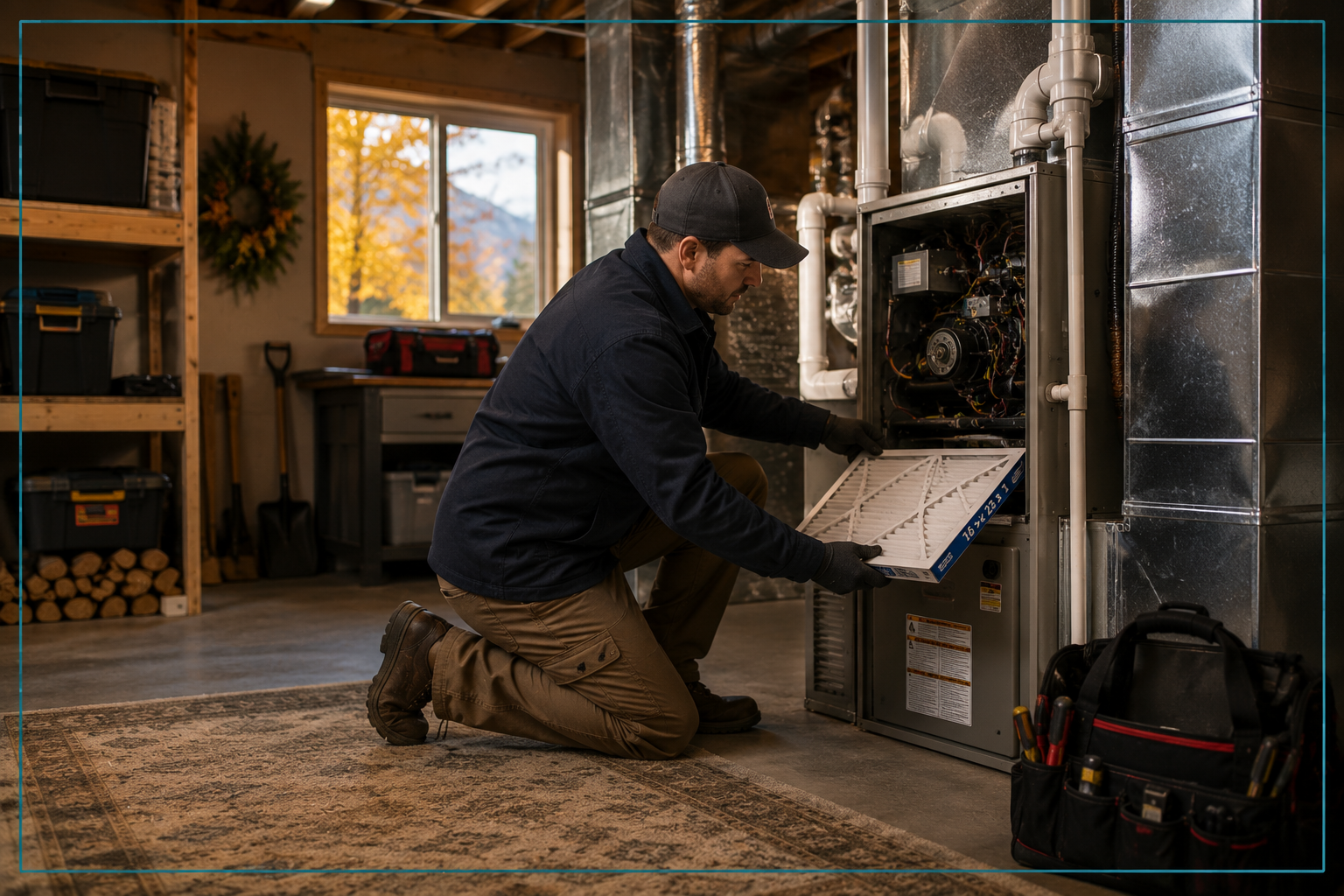
✓ Filters
We check filter location and condition — a dirty filter strains the whole system.
✓ Venting & combustion
We visually check flue/exhaust, combustion air, and gas connections for safety.
✓ Thermostat
We confirm the thermostat operates the system through its modes.
Common problems we find
✓ Neglected filters
Clogged filters choke airflow, waste energy, and shorten equipment life.
✓ Aging equipment
Units past ~15–20 years that are nearing the end of their service life.
✓ Heat-exchanger concerns
Cracks or corrosion are a carbon-monoxide risk — we flag suspect units for professional evaluation.
✓ Duct problems
Disconnected, leaky, or undersized ducts leaving rooms hot or cold.
✓ No service history
Systems that haven’t been serviced in years and are overdue for a tune-up.
✓ Sizing issues
Equipment that’s under- or over-sized, often after an addition.
What you can maintain yourself
✓ Change filters regularly
Every 1–3 months depending on the filter and household — the single highest-impact habit.
✓ Service it annually
Heating in the fall, cooling in the spring, by a licensed technician.
✓ Keep the condenser clear
Maintain a couple feet of clearance around the outdoor unit and rinse off debris.
✓ Don’t block vents
Keep supply and return registers open and unobstructed, and clear snow from exterior terminations.
✓ Test CO detectors
Essential with any combustion appliance — test monthly and replace aging units.
✓ Call early
Short-cycling or odd noises shouldn’t wait — at altitude these units work hard.
Heating and cooling at altitude
✓ Combustion needs derating
Gas appliances lose capacity in thin air — furnaces at Front Range altitude typically need a derate or high-altitude conversion. An improperly set-up unit short-cycles, sooths, and wears early; we look for the signs.
✓ Heating is the main event
Foothills homes heat eight months a year and many skip AC entirely. That means furnaces rack up hours fast — a “15-year” furnace up here has often worked a city furnace’s 20.
✓ Propane changes the math
Beyond the natural-gas grid, homes run propane — different burners, different orifices, a tank with its own inspection needs, and real cost swings by season. We note the setup and its condition.
✓ CO risk deserves respect
Long heating seasons, aging furnaces, and tight winter houses make carbon monoxide protection non-negotiable. Colorado law requires CO alarms near bedrooms in homes with fuel-fired appliances — we check.
Common questions
How long does a furnace last in Colorado?
The rated life is 15–20 years, but Front Range furnaces run long seasons — treat 15+ years as planning territory and 20+ as living on borrowed time. The age is usually decodable from the serial number; we note it in every report along with any signs of deferred maintenance.
Why does my furnace need to be adjusted for altitude?
Air is roughly 17–20% thinner in the Denver-metro foothills than at sea level, so a gas burner gets less oxygen. Manufacturers require derating or a high-altitude kit above ~2,000–4,500 feet depending on the model. Skipping it causes incomplete combustion — inefficiency at best, soot and carbon monoxide at worst.
What does it mean if an inspector flags the heat exchanger?
The heat exchanger separates combustion gases from your household air; a crack can let carbon monoxide into the ductwork. Inspectors can’t fully see it without disassembly, so we flag rust, flame disturbance, or age for a licensed HVAC evaluation. A confirmed cracked exchanger generally means replacing the furnace.
Do Colorado homes need air conditioning?
Plenty of foothills homes above 7,000 feet still skip it — dry air and cool nights do a lot. Denver metro proper increasingly expects AC, and it shows up in resale value. Evaporative (swamp) coolers work well in our dry climate but need seasonal setup/shutdown and winterizing, which we check for.
How often should HVAC be serviced?
Once a year per system: furnace in the fall, AC in the spring — and filters every 1–3 months regardless. Service records matter at resale; a documented maintenance history reads like a well-kept car. No records plus a 12-year-old furnace is one of the most common “budget for this” notes we write.
This guide is for general education. It reflects what we look for during a home inspection, not a substitute for a licensed professional. If you have a specific concern, please contact a licensed HVAC technician — and of course, we’re always happy to take a look during an inspection.
More from our guides
Home Maintenance, Season by Season
A spring-through-winter checklist tuned for Front Range homes.
Read →Radon in Colorado
Why half of Colorado homes test high, county-by-county numbers, and what testing and mitigation really cost — with sources.
Read →Plumbing
Plumbing issues are some of the most common — and most expensive — problems we find. Here’s what we actually look at during an inspection, what tends to go wrong, and what you can stay ahead of yourself.
Read →Concerned about your hvac & furnace?
We’ll give your home a thorough, plain-English inspection and flag anything worth a closer look.